Images

THE ATLANTIC CABLE

THE ATLANTIC CABLE

SUCCESSFUL LAYING OF THE TELEGRAPH CABLE ACROSS THE ATLANTIC OCEAN — 1866

Unnecessary would be the task of detailing, in this place, — additional to those pages already devoted to Professor Morse’s grand discovery, and its practical application the world wide, — the technical principles and operations involved in the science of telegraphic communication.

It was early declared by Professor Morse, and by other distinguished investigators of the nature and powers of the electric current, that neither the ocean itself, nor the distance to be traversed, presented any insuperable obstacle to the laying of submerged oceanic lines from continent to continent, and the confident prophecy that such lines would eventually be undertaken was freely uttered and discussed in learned circles.

It was not, however, until the year 1857, that an attempt was made to stretch a telegraphic wire across the bed of the Atlantic. The cable was coiled half on board the United States steamship Niagara, and half on the British steamer Agamemnon. They began to lay it in mid-ocean on the 26th of June, the Niagara proceeding toward the American coast, the Agamemnon toward Ireland. After the wire had three times broken, the attempt was given up. The following August it was renewed on a different plan. The shore-end was made fast at Valentia Bay, and the Niagara began paying out on the seventh, the arrangement being that the Agamemnon should begin operations when the Niagara had exhausted her half of the cable. On the eleventh, after three hundred and thirty-five miles had been laid, the wire broke again. The third attempt was made with the same vessels in 1858. The ends of the cable were joined in mid ocean, July 29th, and, August 6th, the two vessels arrived simultaneously at their respective destinations. This cable worked for a time, but the electric current grew weak and finally failed altogether.

But these repeated failures, though a severe disappointment to those engaged in the great and costly enterprise, did not destroy their faith in its feasibility, and the mighty task was begun anew, advantage being taken of whatever instruction past experience could furnish or suggest.

Especial care had, it is true, been exercised in the previous undertaking, to have the construction of the cable itself as perfect as possible. It was the result of many months’ thought, experiment, and trial. Hundreds of specimens were made, comprising every variety of form, size, and structure, and most severely tested as to their powers and capabilities; and the result was the adoption of one which, it was believed, possessed all the properties required, in a far higher degree than any cable that had yet been laid. Its flexibility was such as to make it as manageable as a small line, and its strength such that it would bear, in water, over six miles of its own weight suspended vertically. The conducting medium consisted not of one single straight copper wire, but of seven wires of copper of the best quality, twisted round each other spirally, and capable of undergoing great tension without injury. This conductor was then enveloped in three separate coverings of gutta percha, of the best quality, forming the core of the cable, round which tarred hemp was wrapped, and over this, the outside covering, consisting of eighteen strands of the best quality of iron wire, — each strand composed of seven distinct wires, twisted spirally, in the most approved manner, by machinery specially adapted to the purpose. Such was the exquisitely constructed cable used on this occasion.

Great attention was also paid to the arrangement of the apparatus for paying out. The machine for this purpose was placed on deck in the after-part of the vessel, and somewhat on the starboard side, to be clear of the mast, etc. The cable, as it came up from its enormous coils in the hold, passed first through a guiding groove and over a deeply grooved wheel, on to the drums, each of the latter being furnished with four deep grooves, each groove being cut one-eighth of an inch deeper than the former to allow for slack. The cable, after winding round these drums, passed on from the last groove over another guiding wheel, to a distinct piece of machinery, also standing on the deck, and half-way between the brakes and the ship’s stern. Here a grooved wheel worked on a sliding frame, furnished with weights fixed on a rod, which ended in a piston, inside of a cylinder, full of water. This piston, being made not quite large enough to fit the cylinder, the water had room to play about it, but with difficulty — so that, yielding freely to every alteration of pressure, it could do so to none with a jerk, as the piston required some little time to dislodge the water from one side of it to the other, it acting, in short, as a water cushion. From this last piece of machinery the cable passed over a wheel or sheave projecting well over the stern of the ship, and so down into the ocean depths.

So intelligent and powerful an association as that which had this great enterprise in charge — an association composed of some of the leading merchants and capitalists of England and America, guided by the wonderful genius of Mr. Cyrus W. Field, — might well be supposed incapable of yielding to defeat, and thus it was that, until success finally and beyond all peradventure crowned their efforts, they continued their tests and trials of improved machinery and cables, availing themselves of every resource of science, and even bringing into requisition, at last, the magnificent conveniences of conveyance afforded by that “leviathan of the deep,” the steamer Great Eastern.

In this way, certain facts and principles were arrived at, and demonstrated by trials and expeditions conducted in accordance therewith, which showed plainly what had been the errors of the past, and what should be the governing rules of future operations. Among these facts and principles were the following:

It was proved by the expedition of 1858,that a submarine telegraph cable could be laid between Ireland and Newfoundland, and messages transmitted.

By the expedition of 1865 — when the cable was lost — it was demonstrated that the insulation of a cable improves very much after its submersion in the cold deep water of the Atlantic, and that its conducting power is considerably increased thereby; that the steamship Great Eastern, from her size and constant steadiness, and from the control over her afforded by the joint use of paddles and screw, rendered it safe to lay an Atlantic cable in any weather; that in a depth of over two miles, four attempts were made to grapple the lost cable, in three of which the cable was caught by the grapnel, and in the other the grapnel was fouled by the chain attached to it; that the paying-out machinery used on board the Great Eastern worked perfectly, and could be confidently relied on for laying cables across the Atlantic; that with the improved telegraphic instruments for long submarine lines, a speed of more than eight words per minute could be obtained through such a cable as that sunk between Ireland and Newfoundland, as the amount of slack actually paid out did not exceed fourteen per cent., which would have made the total cable laid between Valentia and Heart’s Content nineteen hundred miles; that the lost Atlantic cable, though capable of bearing a strain of seven tons, did not experience more than fourteen hundred-weight in being paid out into the deepest water of the Atlantic between Ireland and Newfoundland; that there was no difficulty in mooring buoys in the deep waters of the Atlantic between Ireland and Newfoundland, and that two buoys even, when moored by a piece of the Atlantic cable itself, which had been previously lifted from the bottom, had ridden out a gale; that more than four nautical miles of the Atlantic cable had been recovered from a depth of over two miles, and that the insulation of the gutta percha covered wire was in no way whatever impaired by the depth of water or the strains to which it had been subjected by lifting and passing through the hauling-in apparatus; that the cable of 1865, owing to the improvements introduced into the manufacture of the gutta percha core, was more than one hundred times better insulated than cables made in 1858, then considered perfect; that the electrical testing could be conducted with such unerring certainty as to enable the electricians to discover the existence of a fault immediately after its production or development, and very quickly to ascertain its position in the cable; and, finally, that with a steam-engine attached to the paying-out machinery, should a fault he discovered on board whilst laying the cable, it was possible to recover it before it had readied the bottom of the ocean, and have it repaired at once.

Still led on by that master-spirit of the enterprise, Mr. Field, its friends formed themselves into a new company, with a large amount of capital, and the summer of 1866 was fixed upon for another effort, the Great Eastern to be employed for the purpose. By the time (says Dr. H. M. Field, the admirable historian of the enterprise,) the big ship had her cargo and stores on board, she was well laden. Of the cable alone there were two thousand four hundred miles, coiled in three immense tanks, as the year before. Of this, seven hundred and forty-eight miles were a part of the cable of the last expedition. The tanks alone, with the water in them, weighed over a thousand tons; and the cable which they held, four thousand tons more; besides which she had to carry eight thousand five hundred tons of coal and five hundred tons of telegraph stores — in all some fourteen thousand tons, besides engines, rigging, etc., which made nearly as much more. So enormous was this burden, that it was thought prudent not to take on board all her coal before she left the Medway, especially as the channel was winding and shallow. It was therefore arranged that about a third of her coal should he taken in at Berehaven, a port on the south-west coast of Ireland. The time for her departure, was the last day of June; and in four or five days she had passed down the Irish coast, and was quietly anchored in the harbor at Berehaven, where she was soon joined by the other vessels of the squadron. The Terrible, which had accompanied the Great Eastern on the former expedition, was still there to represent the majesty of England. The William Corry, a vessel of two thousand tons, bore the ponderous shore end, which was to be laid out thirty miles from the Irish coast, while the Albany and the Medway were ships chartered by the company. While the Great Eastern remained at Berehaven, to take in her final stores of coal, the William Corry proceeded around the coast to Valentia, to lay the shore end. She arrived off the harbor, July 7th, and immediately prepared for her heavy task. This shore end was of tremendous size, weighing over eight tons to the mile. The cable was to be brought off on a bridge of boats, reaching from the ship to the foot of the cliff. All the fishermen’s boats were gathered from along
the shore, while the British war-ship Racoon, which was guarding that part of the coast, sent up her boats to help, so that, as they all mustered in line, there were forty of them, making a long pontoon-bridge; and Irish boatmen with eager looks and strong hands were standing along the line to grasp the massive chain. All went well, and by one o’clock the cable was landed, and its end brought up the cliff to the station. The signals were found to be perfect, and the William Corry then slowly drew off to sea, unlimbering her stiff shore end, till she had cast over the whole thirty miles. At three o’clock, the next morning, she telegraphed through the cable that her work was done, and she had buoyed the end in water a hundred fathoms deep.

The joy of the inhabitants on witnessing this scene was earnest and deep-seated, rather than demonstrative, after the lesson taught by last year’s experience. The excitement was below, instead of above the surface. Nothing could prevent the scene being intensely dramatic, but the prevailing tone of the drama was serious, instead of boisterous and triumphant. Speech-making, hurrahing, public congratulations, and vaunts of confidence, were, as it seemed, avoided as if on purpose. The old crones (says an English paper) in tattered garments who cowered together, dudheen in mouth, their gaudy colored shawls tightly drawn over head and under the chin — the barefooted boys and girls, who by long practice walked over sharp and jagged rocks, which rut up boots and shoes, with perfect impunity — the men at work uncovering the trench, and winding in single file up and down the hazardous path cut by the cablemen in the otherwise inaccessible rock — the patches of bright color furnished by the red petticoats and cloaks — the ragged garments, only kept from falling to pieces by bits of string and tape — the good old parish priest, who exercises mild and gentle spiritual sway over the loving subjects of whom the ever-popular Knight of Kerry is the temporal head, looking on benignly from his car — the bright eyes, supple figures, and innocent faces of the peasant lasses, and the earnestly hopeful expression of all — made up a picture not easily described.

On the thirteenth of July, the fleet was ready to sail on its great errand, and lay the cable in the heart of the wide and deep ocean. Previously to the departure, however, a devotional meeting was held, participated in by the company, the officers and hands, at which the enterprise was solemnly commended to the favor of God. In a short time after leaving the shores of Ireland, the Medway reached the buoy to which the shore-end was attached, and immediately the operation of splicing that end with the main coil on board the Great Eastern was performed.

At about three o’clock, P. M., the telegraph fleet was on its way to Newfoundland, in the following order: The Terrible ahead of the Great Eastern on the starboard bow, the Medway on the port, and the Albany on the starboard quarter. The weather was thick and foggy, with heavy rains. Signals were sent through the cable on board of the Great Eastern and to the telegraph house at Valentia, and the two thousand four hundred and forty nautical miles were found perfect in condition, and only waiting their final destination in the vast womb of the ocean.

All went well until noon of July 18th, when the first real shock was given to the success that had hitherto attended them, and caused considerable alarm. A foul flake took place in the after-tank. The engine was immediately turned astern, and the paying of the cable stopped. All hands were soon on the decks, and there learned, to their dismay, that the running and paying out of the coil had caught three turns of the flake immediately under it, carried them into the eye of the coil, fouling the toy-out and hauling up one-half turns from the outside, and five turns of the eye of the under flakes. This was stopped, fortunately, before entering the paying-out machines; stoppers of hemp with chains were also put on near the wheel astern, and orders were given by Mr. Canning, to stand by to let go the buoy. This was not very cheering to hear; but, though the calm and collected man inspired those around him with confidence that his skill and experience would extricate the cable from the danger in which it was placed, no fishing line was ever entangled more than the rope when thrust up in apparently hopeless danger from the eye of the cable to the deck.

There were at least five thousand feet of rope lying in this state, and in the midst of thick rain and increasing wind, the cable crew set to work to disentangle it. The Dolphin was there, too, patiently following the lights as they showed themselves, the crew now passing them forward and now aft, until at last the character of the tangle was seen, and soon it became apparent that ere long the cable would be saved and uninjured down to the tank. Captain Anderson was at the taffrail, anxiously, watching the strain on the rope (they could scarcely make it out, the night was so dark), endeavoring to keep it up and down, going on raising with paddle and screw. In view of the rise of the great ship, and the enormous mass she presented to the wind, the difficulty of keeping her stern, under the circumstances, over the cable, can be appreciated. The port paddle-wheel was disconnected, but afterward there was a shift of wind, and the vessel came-to the wrong way.

Welcome voices were now heard passing the word aft from the tank, that the bights were cleared, and to pay out. Then the huge stoppers were quietly opened, and at 2:05 AM to the joy of all, the cable was once more being discharged. They veered it away in the tank to clear the screw, and the paddle-engines were slowed so as to reduce the speed of the ship to four and a half knots. During all this critical time, there was entire absence of noise and confusion. Everything was silently done, and the cable men and crew worked with hearty good will.

On the morning of Friday, at eight o’clock, July 27th, the ship arrived at
Heart’s Content, the American terminus, the distance run being one thousand six hundred and sixty-nine miles, and the length of cable paid out, one thousand eight hundred and four miles. The average speed of the ship from the time the splice was made until they came in sight of hand was a little less than five nautical miles per hour, and the cable was paid out at an average of five and one-half miles per hour. The total slack was less than twelve per cent. The fleet was in constant communication with Valentia since the splice was made, July 13th, and news was daily received from Europe, which was posted up outside of the telegraph office, for the information of all on board of the Great Eastern, and was signaled to the other ships. It would be difficult to describe the feelings with which Mr. Field, who, with his associates on board, had watched the progress of the undertaking with intense solicitude, day and night, — penned the following announcement to his friends in New York, and which was received throughout the whole land with unbounded delight: —

“HEART’S CONTENT, July 27. We arrived here at nine o’clock, this morning. All well. Thank God, the cable is laid, and is in perfect working order.
CYRUS W. FIELD”

Strangely and happily enough, too, the first European tidings flashed across the cable to the western hemisphere, was, that a treaty of peace had just been signed between Austria and Prussia, and that the black war cloud which had gathered over all Europe was fast fleeing away; — a fit celebration of the grandest of human enterprises, the successful establishment of telegraphic communication between the Old world and the New.

Congratulatory dispatches were immediately forwarded, by Mr. Field, to the president of the United States, the secretary of state, and to the honorary directors of the Atlantic Telegraph Company. The queen of England sent her salutations to the president, as follows: “The Queen congratulates the President on the successful completion of an undertaking which she hopes may serve as an additional bond of union between the United States and England.” To this, the president responded by saying: “The President of the United States acknowledges with profound gratification the receipt of Her Majesty’s dispatch, and cordially reciprocates the hope that the cable which now unites the eastern and western hemispheres may serve to strengthen and to perpetuate peace and amity between the Government of England and the Republic of the United States.”

Heart’s Content, the American terminus of the cable, is a little fishing hamlet, hitherto unknown, but destined to an enduring reputation hereafter, as one of the most interesting geographical points in the history of the age. The bay on which it is situated is a very safe and capacious one, and on this account was selected.

Among the complimentary messages sent to Mr. Field, on the consummation of his great and magnificent scheme, was one which came to hand on Monday, July 30th, from M de Lesseps, the renowned projector of the Suez Canal. It was dated in Alexandria, Egypt, the same day, at half-past one o’clock, P.M., and reached Newfoundland at half-past ten, A. M. By looking at the globe, one can see over what a space that message flew. Remarking upon the wonderful fact, a New York paper graphically said that it came from the farthest East, from the land of the Pharaohs and Ptolemies; it passed along the shores of Africa, and under the Mediterranean, more than a thousand miles, to Malta; thence it leaped to the continent, and shot across Italy, and over the Alps. and then through France, under the Channel, to London; then across England and Ireland, till from the cliffs of Valentia it struck straight into the Atlantic, darting down the submarine mountain which lies off the coast, and over all the hills and valleys of the watery plain, resting not till it touched the shore of the New World. Thus, in its morning’s flight, it had passed over one-fourth of the earth’s surface, and so far outstripped the sun in his course, that, by the dial, it reached its destination three hours before it was sent! Curiously enough, too, in this latter connection, it was found, when considering the propriety of not sending messages on Sunday, that, supposing no delay in transmission, Sunday in the United States is Saturday in Calcutta, and thus the adoption of such a rule would be — working eastward and westward — to exclude Saturday, Sunday, and Monday, from telegraph operations.

As illustrating the moral uses, too, sub-served by land and ocean telegraph lines connecting different countries and continents, the following case, given in a New York journal — by no means an extreme case in this present day of increased telegraphic facilities — will be found in point: A knavish Chinaman in California having contracted the barbarian vice of swindling, has been cheating sundry merchants in San Francisco out of eighteen thousand dollars, and, getting on board the Pacific Mail steamship, fled to the Central Flowery Kingdom, in this way he hoped to put between himself and those whom he had robbed, first, some ten thousand miles of ocean. But, a telegram from San Francisco bears the tidings of his crime to New York. New York sends it by cable across the Atlantic to London, London through France and under the Mediterranean to. Alexandria, Alexandria by the Red Sea and Persian Gulf to Bombay, Bombay to Ceylon, and Ceylon by the Peninsula and Oriental steamers to China. So that, when Hong-Kee trips lightly down the ship’s gangway at Hong Kong or Shanghai, dreaming of much opium and many almond-eyed daughters of the Sun in the Land of flowers, his placid soul will be disconcerted by the tap of a bamboo on his shoulder, and a voice of doom will murmur an ungentle summons in his ear. Poor Hong-Kee! The bad morals of the Christians have corrupted him, and in the steam-engine of the Christians has he put his trust. But the literal ‘chain-lightning’ of those same Christians is after him, to outstrip their steam-engine, and to teach him in sorrow and in shame how much better he might have done.

Not less curious, in a scientific point of view, is the following incident, as related by Mr. Field, at the magnificent banquet given in his honor, in New York, on the triumphant completion of what has justly been pronounced the grandest of human enterprises. “The other day,” said Mr. Field, in his speech on this occasion, “Mr. Lattimer Clark telegraphed from Ireland, across the ocean and back again, with a battery formed in a lady’s thimble! And now Mr. Collett writes me from Heart’s Content: “I have just sent my compliments to Doctor Gould, of Cambridge, who is at Valentin, with a battery composed of a gun cap, with a strip of zinc, excited by a drop of water, the simple bulk of a tear!'”

Too great credit can never be awarded to Mr. Field, for his persevering devotion to this enterprise, through ten years of disheartening failure. In the early stages of the enterprise, few encouraged him in his expectations, though all personally wished him well. On preparing, therefore, for one of his trips across the Atlantic, in connection with the business, one of his friends said to him, “When shall we see you again?” “Not until I have laid the cable” was Mr. Field’s reply. So, too, on presenting the subject to Lord Clarendon. The latter showed great interest and made many inquiries, but was rather startled at the magnitude of the proposed scheme, as well as at the confident tone of the projectors, and pleasantly asked the lion-hearted man —

“But, suppose you don’t succeed? Suppose you make the attempt and fail — your cable is lost in the sea — then what will you do?”

“Charge it to profit and loss, and go to work to lay another,” was Mr. Field’s quick and characteristic response to his noble friend.

On another occasion, when dining at the residence of Mr. Adams, the American ambassador, in London, he was seen for an instant to nod his head. John Bright, who sat next to him, turned to him with a smile, and said, “I am glad to see you sleep; I didn’t know that you ever slept!” — a most pertinent and deserved tribute to the man whose indomitable faith and energy was finally crowned with immortal success.

Images

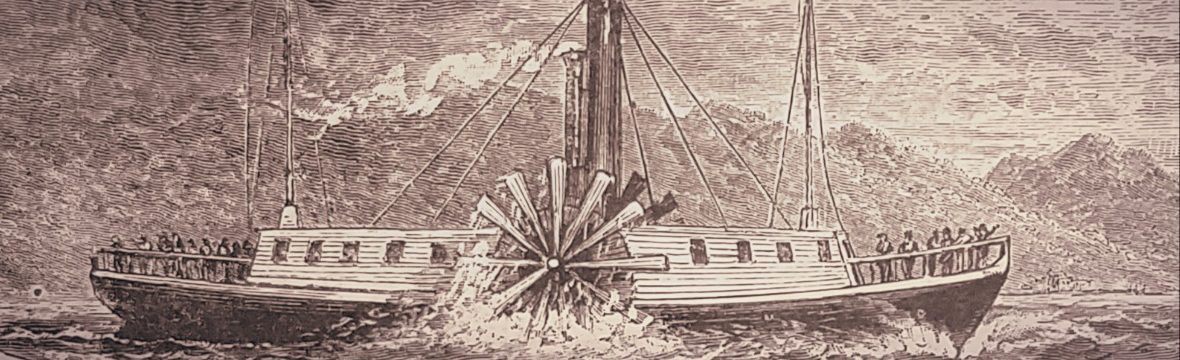
FULTON’S FIRST STEAMBOAT

FULTON’S FIRST STEAMBOAT

FULTON’S TRIUMPHANT APPLICATION OF STEAM TO NAVIGATION — 1807

Steam, in its application to the purposes of navigation, was first successfully employed by Robert Fulton, a native of Little Britain, Pennsylvania. His peculiar genius manifested itself at an early age, in an irrepressible taste for producing drawings and various mechanisms. At the age of twenty-one he was intimate with Franklin. He had previously painted portraits and landscapes in Philadelphia, and derived considerable profit from the occupation. He subsequently sailed for England, with the view of seeking Mr. West’s aid in the prosecution of his art. That great painter took him into his family, at once. In 1793, Fulton was actively engaged in a project to improve inland navigation. Even at that time he had conceived the idea of propelling vessels by steam. In 1804 he had acquired much valuable information upon the subject, and written it down, as well as much concerning his own life, and sent many manuscripts from Paris to this country, but the vessel was wrecked and most of the papers destroyed. About this period, the subject of canals seems to have been the principal object of his attention, although not exclusively. In 1806, Mr. Fulton left Europe for New York, and on his arrival in this country, he immediately commenced his arduous exertions in the cause of practical science. The fertility of his mind in this direction may be understood, when it is stated that, in 1794, he had been engaged by the Duke of Bridgewater in canal projects, had adopted and patented the system of inclined planes as a substitute for locks, and had written a treatise on canals. He also invented a mill for sawing marble, patented several methods of spinning flax and making ropes, and constructed a torpedo to be used in war, for the destruction of an enemy’s vessels.

At what time Mr. Fulton’s mind was first directed to steam navigation, is not definitely known; but even in 1793, he had matured a plan in which he reposed great confidence. No one, previously to Mr. Fulton, had constructed a steamboat in any other way, or with any other result, than as an unsuccessful experiment; and although many have disputed his right to the honor of the discovery, none have done so with any semblance of justice. Miller’s experiments, which simply proved the practicability of the principle of propelling vessels by steam, were made in 1787, in Scotland; but Fulton’s boat, which began to navigate the Hudson in 1807, was certainly the first practical demonstration of this application of steam, being five years prior to the success of Henry Bell on the Clyde, and nearly ten years preceding the first attempts on the Thames river, under Brunel’s direction. The incompleteness of Fitch’s plan is matter of history, though his inventive ingenuity was very great.

Among those of Fulton’s own countrymen who had previously made unsuccessful attempts to render the force of steam subservient to practical and useful purposes, was Chancellor Livingston, of New York. As early as 1798, he believed that he had accomplished his object, and represented to the legislature of the state of New York, that he possessed a mode of applying the steam engine so as to propel a boat on new and advantageous principles; but he was deterred from carrying it into effect, by the uncertainty and hazard of a very expensive experiment, unless he could be assured of an exclusive advantage from it, should it be found successful.

The legislature in March, 1798, passed an act vesting Mr. Livingston with the exclusive right and privilege of navigating all kinds of boats which might be propelled by the force of fire or steam, on all the waters within the territory or jurisdiction of the state of New York, for a term of twenty years from the passing of the act, — upon condition that he should within a twelvemonth build such a boat, the mean of whose progress should not be less than four miles an hour.

The bill was introduced into the house of assembly by Dr. Mitchell, upon which occasion the wags and the lawyers united their powers in opposition to the bill in such a manner that the good doctor had to encounter all their jokes, and parry all their blows.

According to Mr. Livingston’s own account of these most interesting circumstances, it appears that, when residing as minister plenipotentiary of the United States in France, he there met with Mr. Fulton, and they formed that friendship and connection with each other, to which a similarity of pursuits naturally gives birth. He communicated to Mr. Fulton his views of the importance of steamboats to their common country; informed him of what had been attempted in America, and of his resolution to resume the pursuit on his return; and advised him to turn his attention to the subject. It was agreed between them to embark in the enterprise, and immediately to make such experiments as would enable them to determine how far, in spite of former failures, the object was attainable. The principal direction of these experiments was left to Mr. Fulton.

On the arrival at New York of Mr. Fulton, which was not till 1806, they immediately engaged in building a boat — of as was then thought — very considerable dimensions, for navigating the Hudson. This boat, named the Clermont, was of one hundred and sixty tons burden, one hundred and thirty feet long, eighteen feet wide, and seven feet deep. The diameter of the paddle-wheels was fifteen feet, the boards four feet long and dipping two feet in the water. She was a queer-looking craft, and, while on the stocks, excited much attention and no small amount of ridicule. When she was launched, and the steam engine placed in her, that also was looked upon as being of a piece with the boat built to float it. A few had seen one at work raising the Manhattan water into the reservoir back of the almshouse; but, to the people at large, the whole thing was a hidden mystery. Curiosity was greatly excited. Nor will the reader be at all surprised at the statement made by an eye-witness and narrator of these events, that, when it was announced in the New York papers that the boat would start from Cortlandt street at six and a half o’clock on Friday morning, the fourth of August, and take passengers to Albany, there was a broad smile on every face, as the inquiry was made, if any one would be fool enough to go? One friend was heard to accost another in the street with —

“John, will thee risk thy life in such a concern? I tell thee she is the most fearful wild fowl living, and thy father ought to restrain thee!”

When Friday morning came, the wharves, piers, housetops, and every ‘coigne de vantage’ from which a sight could be obtained, was filled with spectators. There were twelve berths, and every one was taken through to Albany. The fare was seven dollars. All the machinery was uncovered and exposed to view. The periphery of the balance-wheels, of cast iron, some four or more inches square, ran just clear of the water. There were no outside guards, the balance-wheels being supported by their respective shafts, which projected over the sides of the boat. The forward part was covered by a deck, which afforded shelter to the hands. The after-part was fitted up, in a rough manner, for passengers. The entrance into the cabin was from the stern, in front of the steersman, who worked a tiller, as in an ordinary sloop. Black smoke issued from the chimney; steam issued from every ill-fitted valve and crevice of the engine. Fulton himself was there. His remarkably clear and sharp voice was heard above the hum of the multitude and the noise of the engine; his step was confident and decided; he heeded not the fearfulness, doubts, or sarcasm of those by whom he was surrounded. The whole scene combined had in it an individuality, as well as an interest, which comes but once and is remembered forever.

Everything being ready, the engine was set in motion, and the boat moved steadily but slowly from the wharf; as she turned up the river, and was fairly under way, there arose such a huzza as ten thousand throats never gave before. The passengers returned the cheer, but Fulton stood upon the deck, his eyes flashing with an unusual brilliancy as he surveyed the crowd. He felt that the magic wand of success was waving over him, and he was silent.

As the boat sailed or steamed by West Point, the whole garrison was out, and cheered most lustily. At Newburg, it seemed as if all Orange county was collected there; the whole side-hill city seemed animated with life. Every sailboat and water-craft was out. The ferryboat from Fishkill was filled with ladies, but Fulton was engaged in seeing a passenger landed, and did not observe the boat until she bore up nearly alongside; the flapping of a sail arrested his attention, and, as he turned, the waving of so many handkerchiefs, and the smiles of so many bright and happy faces, struck him with surprise, and, raising his hat, he exclaimed, “That is the finest sight we have seen yet.”

In a letter to his friend and patron, Mr. Barlow, Fulton says of this Clermont trial trip: “My steam-boat voyage to Albany and back has turned out rather more favorable than I had calculated. The distance to Albany is one hundred and fifty miles. I ran up in thirty-two hours and down in thirty. The latter is just five miles an hour. I had a light breeze against me the whole way, going and coming, so that no use was made of my sails, and this voyage has been performed wholly by the power of the steam engine. I overtook many sloops and schooners beating to the windward, and passed them as if they had been at anchor.” Such was the modest description of this greatest of modern inventions.

Of peculiar interest and entertainment is the following narrative connected with this historic voyage, from the graphic pen of one who was a personal actor in the scene described: —

I chanced to be at Albany on business when Fulton arrived there in his unheard of craft, which everybody felt so much anxiety to see. Being ready to leave, and hearing that this craft was going to return to New York, I repaired on board and inquired for Mr. Fulton. I was referred to the cabin, and there found a plain, gentlemanly man, wholly alone, and engaged in writing.

“Mr. Fulton, I presume.”

“Yes, sir.”

Do you return to New York, with this boat?”

“We shall try to get back, sir.”

“Can I have a passage down?”

“You can take your chance with us, sir.”

I inquired the amount to be paid, and, after a moment’s hesitation, a sum, I think six dollars, was named. The amount, in coin, I laid in his open hand, and, with his eye fixed upon it, he remained so long motionless, that I supposed it might he a miscount, and said to him, “Is that right, sir?” This question roused him as from a kind of reverie, and, as be looked up, the big tear was brimming in his eye, and his voice faltered as he said —

“Excuse me, sir; but memory was busy as I contemplated this, the first pecuniary reward I have ever received for all my exertions in adapting steam to navigation. I should gladly commemorate the occasion over a bottle of wine with you, but really I am too poor even for that, just now; yet I trust we may meet again, when this will not be the case.”

Some four years after this (continues the writer of this agreeable reminiscence), when the Clermont had been greatly improved and her name changed to the North River, and when two other boats, viz., the Car of Neptune and the Paragon had been built, making Mr. Fulton’s fleet consist of three boats regularly plying between New York and Albany, I took passage upon one of these for the latter city. The cabin in that day was below; and, as I walked its length to and fro, I saw I was very closely observed by one I supposed a stranger. Soon, however, I recalled the features of Mr. Fulton; but, without disclosing this, I continued my walk. At length, in passing his seat, our eyes met, when he sprang to his feet, and, eagerly seizing my hand,
exclaimed —

“I knew it must be you, for your features have never escaped me; and, although I am still far from rich, yet I may venture that bottle now!”

It was ordered; and during its discussion Mr. Fulton ran rapidly, but vividly, over his experiences of the world’s coldness and sneers, and of the hopes, fears, disappointments, and difficulties, that were scattered through his whole career of discovery, up to the very point of his final, crowning triumph, at which he so fully felt he had arrived at last. And in reviewing all these matters, he said —

“I have again and again recalled the occasion, and the incident, of our first interview at Albany; and never have I done so without renewing in my mind the vivid emotion it originally caused. That seemed, and does still seem, to me, the turning point in my destiny — the dividing line between light and darkness, in my career upon earth; for it was the first actual recognition of my usefulness to my fellow-men.”

Even at this early period in the employment of so dangerous and slightly understood a motive power as steam, the rivalry and diversion of racing was indulged in. It was in the month of September, 1809, that the exciting and criminal scene of a steam-boat race was first enacted. A company from Albany had been formed for the purpose of competing with Fulton. The first vessel of this opposition line was advertised to leave Albany at the same time as Fulton’s. Parties ran high in the hotels of Albany. The partisans of Fulton were enrolled under Professor Kemp, of Columbia College; those of the opposition under Jacob Stout. The victory was long in suspense; and it was not until after the thirtieth hour of a hard struggle that the result was proclaimed by Dr. Kemp, on the taffrail of Fulton’s vessel, and holding out, in derision, a coil of rope to Captain Stout, for the purpose, as he remarked in so doing, of “towing him into port.” When the age, high standing, and sedate character of these two gentlemen are considered, it is not surprising that, in course of time, women at the West learned to devote their bacon to feeding the furnace fires of rival steam-boats.

The complete success attending steam navigation on the Hudson and the neighboring waters, previous to the year 1809, turned the attention of the principal projectors to the idea of its application on the western waters; and in the month of April of that year, Mr. Roosevelt, of New York, pursuant to an agreement with Chancellor Livingston and Mr. Fulton, visited those rivers, with the purpose of forming an opinion whether they admitted of steam navigation or not. Mr. Roosevelt surveyed the rivers from Pittsburg to New Orleans, and, as his report was favorable, it was decided to build a boat at the former place. This was done under his direction, and in the year 1811 the first boat was launched on the waters of the Ohio. It was called the New Orleans.

Late at night, on the fourth day after quitting Pittsburg, they arrived in safety at Louisville, having been seventy hours descending a distance of somewhat more than seven hundred miles. The novel appearance of the vessel, and the fearful rapidity — as it was then regarded — with which it made its passage, excited a mixture of terror and surprise among many of the settlers on the banks, whom the rumor of such an invention had never reached.

Mr. Livingston’s former associate in his experiments with applying steam to this purpose was Mr. John Stevens, of New Jersey, who persevered independently of Fulton and his patron, in various attempts to construct steam-boats. In this enterprise he was aided by his son, and his prospects of success had become so flattering, that he refused to renew his partnership with Livingston, and resolved to trust to his own exertions. Fulton’s boat, however, was first ready, and thus secured the grant of the exclusive privilege of the state of New York. The Stevenses were but a few days later in moving a boat with the required velocity. Being shut out of the waters of the state of New York, by the priority of Livingston and Fulton, Stevens conceived the bold design of conveying his boat to the Delaware by sea; and this boat, which was so near reaping the honor of first success, was the first to navigate the ocean by steam. One of the most efficient advocates of the new mode of navigation by steam was DeWitt Clinton.

From the date of Fulton’s triumph in 1807, steam navigation became a fixed fact in the United States, and went on extending with astonishing rapidity. Nor could a different result have been rationally expected in such a country as America.

In person, Mr. Fulton was about six feet high, slender form, but finely proportioned. Nature had made him a gentleman, and bestowed upon him ease and gracefulness. A modest confidence in his own worth and talents, gave him an unembarrassed deportment in all his social intercourse. He expressed himself with energy, fluency, and correctness, and, as he owed more to his own experience and reflections than to books, his sentiments were often interesting from their originality. But what was most conspicuous in his character, was his calm constancy, his industry, and that indefatigable patience and perseverance, which always enabled him to overcome difficulties.

Images

COMPLETION OF THE PACIFIC RAILROAD

COMPLETION OF THE PACIFIC RAILROAD

BELIEVERS in the “manifest destiny” of the universal Yankee nation were favored with one of the most conclusive and gratifying confirmations of their cherished theory, when that most stupendous work ever undertaken by man, the Construction of the Pacific Railway, was finally consummated by the laying of the last rail and the memorable ceremony performed by officials of clasping together the iron girdle about the loins of the nation; — in the winding of which mighty coil across the continent, mountains were tunneled which made one’s head giddy to gaze upon; rivers were bridged which, since the primeval days of creation, had rolled in majestic solitude; gulfs, frightful and tumultuous, were spanned; frowning heights were climbed and leveled; and abysmal depths were fathomed. And all this was accomplished in a period of time, and on a scale of magnitude, the recital of which is fairly calculated to stagger credulity.

Notwithstanding the necessity of such a line of communication had for years been repeatedly urged, it was not until 1859 that a bill was carried through congress, authorizing the grand scheme. This bill, — according to the Chicago Times’ exhaustive account of the history of the enterprise, which is here abridged, — comprised no less than three great lines, namely, the northern, the southern, and the central. But the breaking out of the civil war checked the enterprise. The astonishing development, however, of the precious metals in Nevada and the travel and traffic that inevitably followed, embodied for the mines of Californians that imperious need of a cheaper and easier conveyance, into a plan of a continental railway, which had always been popular there.

The assumed impracticability of crossing the Sierras did not discourage a few daring, far-sighted engineers, prominent among whom was Mr. T. P. Benjamin, the character of whose surveys decided the state legislature to charter the Central Pacific railroad company in 1862. In a short time, success crowned the efforts of the friends of the enterprise in congress; and so, in July, 1862, the great continental railway from the Missouri to the Pacific was an assured undertaking. In 1865, forty miles were built; in 1866, two hundred and sixty-five miles; in 1867, two hundred and forty-five miles; in 1868, four hundred and twenty-five miles; in 1869, one hundred and five miles. East of Salt Lake City, the elevation of the road averages about seven thousand feet above the sea. Most of the country is very rough, destitute of wood and water, and a large portion of the way is through an alkali desert. Tremendous snow-storms in the mountains presented another great difficulty.

The spirit of rivalry did its share in stimulating the activity of the Union Pacific company. The efforts of this company had so far languished during the earlier history of their corporation, that little was done till after the close of the war. The Central Pacific, however, immediately commenced work, so that, in January, 1863, the first grading was done, — the occasion being signalized with great rejoicing as a general holiday, — and even so early as June, 1864, thirty-one miles of track had been laid to New Castle, nearly one thousand feet above the sea at the foot of the Sierras. But, owing to financial difficulties, it was not until September, 1866, that progress was made to Alta, seventy miles east of Sacramento, and neatly six thousand feet above the sea. In November following, the track reached Cisco, some six thousand feet above the sea, an average elevation of about one hundred feet per mile being overcome in twenty-three miles.

Work on the Union Pacific did not commence till eighteen months after the Central had inaugurated their section of the enterprise. In the spring of 1867, when the snows had melted, the work was resumed by both companies, with great vigor, the race being kept up with an ardor that constantly gathered head. The Union was far ahead in respect to distance, but they had to fight against continually increasing difficulties, while the Central had already overcome the great ones of their undertaking in crossing the Sierras, and could look forward to an open and easy route. The first passenger train reached the top of the Sierras, November 30, 1867. By the time the western end of the route had reached the lower Truckee, one hundred and forty miles east of Sacramento, the Union had reached a point in the Black Hills, five hundred miles west of Omaha.

At the opening of the summer of 1868, the two companies were nearly equally distant from Monument Point, at the head of Salt Lake, and the emulation between the two gave rise to prodigious efforts. About twenty-five thousand men and six thousand teams were engaged along the route between the foot of the Sierras and Evans’s pass. The competition increased as they neared each other, and at last the struggle arose as to the point of junction. The Central company wished Ogden fixed as the point of junction, and the Union urged Monument Point; the matter was at last settled by a decision in favor of the former. The dangers to which the laborers were subjected, and the imperious necessity of vigilant protection of the track and material of the road, were great and unceasing, owing to the inveterate hostility of the Indians. From Fort Kearney west, up the Platte river, to the foot of the Black Hills, the road was subject to a continual succession of fierce attacks. Several battalions of United States troops were scattered along the line, and found full employment in adequately guarding the object of their vigilance.

That the completion of such a vast enterprise, unparalleled in magnitude and grandeur, should be hailed as one of the most memorable achievements in the material progress of the country, was certainly to be expected. Nor is it to be wondered at that the original pick and shovel employed in commencing such a work, should still be looked upon, by every patriot, with historic interest. They are carefully preserved, and bear the following inscriptions:

“Pick that struck the first blow on the Union Pacific railroad, Omaha, December 2, 1863. Pickers: Thomas Acheson, Wilson F. Williams, George Francis Train, Peter A. Day.”

“Shovel used by George Saunders, to move the first earth in the Union Pacific railroad, Omaha, Neb., December 3, 1863. Shovelers: Alvin Saunders, governor of Nebraska; B. E. B. Kennedy, mayor of Omaha; I. M. Palmer, mayor of Council Bluffs; Augustus Kountze, director of U. P. R. R.”

The following table of distances on the two lines will show the magnitude of this great channel of continental communication: From New York to Chicago, 911 miles; from Chicago to Omaha, Neb., 491 miles. From Omaha, by the Union Pacific line, to Ogden, 1,030, and a branch of forty miles to Salt Lake City. From Ogden, by the Central Pacific line, 748 miles. From Sacramento to San Francisco, 120 miles. Thus, the grand distance, by the iron track, from Omaha to San Francisco, is 1,898 miles; from Chicago to San Francisco, 2,389; from New York to San Francisco, 3,377 miles.

In less than one-half or one-third of the time predicted at the outset of the enterprise, the road was completed, — a great feat, indeed, when it is considered that the workmen operated at such a distance from their base of supplies, and that the materials for construction and subsistence had to be transported under such a variety of difficulties. Thus, the transportation of one hundred and ten thousand tons of iron rails, one million fish-plates, two million bolts, fifteen million spikes, three and a half million cross-ties, and millions of feet of timber not estimated, for the construction of roads, culverts and bridges, made one of the minor items of the account. The moving of engines and machinery for stocking manufactories, of materials for foundries and buildings of every kind, not to speak of the food for an army of thousands of workmen, all of which belong to the single account of transportation, may also give an impression of the activity and expense required in bringing such a road to completion in so short a time.

Of course the irregularities of surface characterizing a distance so immense, and particularly that portion of the line running among the Sierra Nevada mountains, necessitated tunneling, cutting, and trestle-bridging, on a large scale. The well-known Bloomer Cut, sixty-three feet deep and eight hundred feet long, is through cemented gravel and sand, of the consistency of solid rock, and only to be moved by blasting. The trestle-bridging constituted one of the most important features in the construction of the road, and the work, on completion, was pronounced of the most durable description. Among the most famous of these structures may be mentioned the trestle and truss bridge, Clipper ravine, one hundred feet high; the Long ravine, Howe truss bridge and trestle, one hundred and fifteen feet high; and the trestle at Secrettown, one thousand feet long, and fifty to ninety feet high. The highest engineering skill was demanded, from first to last, and the triumphs of science, in this respect, were complete.

The total mileage of the roads built under the direct authority and by the aid of the national government, was two thousand four hundred miles. The government subsidy in aid of these works, amounted to about $64,000,000, of six percent currency bonds, the companies being also authorized to issue an equal amount of bonds. Both companies had also a land grant from congress, in alternate sections, equal to twelve thousand eight hundred acres per mile.

Ninety million dollars was the cost of the Union Pacific railroad, up to 1869; that of the Central Pacific, seventy-five million. This enormous sum, especially in its relation to the government indebtedness, alarmed some timid economists. But a sufficient answer to their arguments was, that millions upon millions of acres of government lands, hitherto lying idle, would come into the market, and very speedily appear as productive farms tilled by the hand of industry; that towns, villages, cities, manufacturing, mining, and all the appliances and evidences of material progress, would at once take a start, the wealth of the East be poured into the West, and emigration westward populate territories and turn them into states as if by magic. By means of this new and wonderful highway, the distance from New York to San Francisco would be traversed by passengers in six or seven days, instead of three weeks or more via Panama. From San Francisco to Japan is nineteen days, or twenty-five from New York, and some thirty-six from London, a speed exceeding that of the British mails to Yokohama, via Suez, by upwards of twenty days. And thus, San Francisco, on the Pacific, the travel and commerce of the nations of Western Europe with the hundreds of millions of people of Eastern Asia, and the great island of Australia, would pass over the railway, — the land that built it thereby reaping the benefit of being the world’s highway.

On the tenth of May, 1869, the grand historic event took place at Promontory Point, Utah, of uniting the two great divisions of the trans-continental railway. Early in the morning, says the Chicago Tribune, Governor Stanford and party from the Pacific coast were on the ground; and at half-past eight, an engine with a palace and two passenger cars arrived from the east bringing Vice-President Durant and directors Duff and Dillon, of the Union Pacific railroad, with other distinguished visitors, including several Mormon apostles. Both parties being in readiness, the ties were thrown down on the open space of about one hundred feet, and the employes of the two companies approached with the rails to fill the gap. Mr. Stenbridge, subcontractor, who had been in charge of the building of the Central Pacific from the laying of the first rail on the bank of the Sacramento, commanding a party of Chinese track-layers, advanced from the west with assistant – general superintendent Corning.

The Chinamen, conscious that the strangers from the far east were watching their movements with curious eyes, wielded the pick, shovel and sledge, with consummate dexterity; but their faces wore an appearance of unconcern and indifference wonderful if real, and not the less so if affected. White laborers from the east did their best work, but with more indication of a desire to produce an effect, and at eleven o’clock the European and Asiatic private soldiers of civilization stood face to face in the heart of America, each proudly conscious that the work was well done, and each exultant over so noble a victory. Engine No. 119 from the Atlantic, and Jupiter, No. 60, from the Pacific, each decorated with flags and evergreens for the occasion, then approached within a hundred feet from opposite directions, and saluted with exultant screams. Superintendent Vandenburgh now attached the telegraph wires to the last rail, so that each blow of the sledge should be recorded on every connecting telegraph instrument between San Francisco and Portland, Me. It was also arranged so that corresponding blows should be struck on the bell in the city hall at San Francisco, and the last one fire a cannon in the batteries at Fort Point. General Safford, on behalf of the territory of Arizona, presented a spike composed of iron, gold and silver, as an offering by Arizona, saying:

“Ribbed with iron, clad in silver, and crowned with gold, Arizona presents her offering to the enterprise that has banded every continent and dictated a new pathway to commerce.”

The crowd fell back at the request of General Casement, and the artist for the Union Pacific railroad photographed the scene, with the locomotives confronting each other, and Chinese and Caucasian laborers confronting the work. It was now announced that the last blow was to be struck. Every head was uncovered in reverential silence, while Rev. Dr. Todd, of Pittsfield, Mass., offered up a brief and deeply impressive invocation.

The magnificent tie of laurel, on which was a commemorative plate of silver, was brought forward, put in place, and Doctor Harkness, in behalf of the state of California, presented Governor Stanford the gold spike. President Stanford, of the Central Pacific railroad, responded, accepting the golden and silver tokens, predicting the day as not far distant when three tracks would he found necessary to accommodate the traffic which would seek transit across the continent, and closing with the happy summons — “Now, gentlemen, with your assistance, we will proceed to lay the last rail, the last tie, and drive the last spike.”

General Dodge, in behalf of the Union Pacific railroad, responded as follows: “Gentlemen, — The great Benton prophesied that some day a granite statue of Columbus would be erected on the highest peak of the Rocky mountains pointing westward, denoting this as the great route across the continent. You have made that prophecy this day. Accept this as the way to India.” Mr. Tuttle, from Nevada, presented a silver spike on behalf of the citizens of that state, with the following remarks: “To the iron of the East and the gold of the West, Nevada adds her link of silver, to span the continent and wed the oceans.” Thereupon, Superintendent Coe, in behalf of the Pacific Union express, presented the silver hammer, or sledge, with which to drive the last spike.

Governor Stanford and Vice-President Durant advanced, took in hand the sledge, and drove the spike, while the multitude stood silent. Mr. Miles, of Sacramento, who was chairman of the meeting, announced the great work done! The silence of the multitude was now broken, and a prolonged shout went forth, which, while it yet quivered on the gladdened air, was caught up by the willing lightning, and borne to the uttermost parts of the earth. Cheer followed cheer for the union of the Atlantic and Pacific, the two Pacific railroad companies and their officers, the president of the United States, the Star Spangled Banner, the laborers, etc. A telegram announcing the grand consummation was sent at once to President Grant, and one to the associated newspaper press immediately followed, worded thus:

“The last rail is laid! The last spike driven! The Pacific Railroad is completed! The point of junction is 1,086 miles west of the Missouri river, and 690 miles east of Sacramento City.”

There was a great deal of interest and excitement in Washington, and a large crowd assembled at the telegraph office, as soon as it was known that the driving of the last spike would be announced by the wires. Mr. Tinker, the manager, fixed a magnetic ball in a conspicuous place, where all present could witness the performance, and connected the same with the main lines, notifying the various offices throughout the country, that he was ready. New Orleans, New York and Boston, instantly answered that they were ready. Soon afterward, many of the offices in different parts of the country began to make all sorts of inquiries of the office at Omaha, from which point the circuit was to be started. That office replied:

“To everybody: Keep quiet. When the last spike is driven at Promontory Point, we will say “Done.” Don’t break the circuit, but watch for the signals of the blows of the hammer.”

After some little delay, the instruments were all adjusted, and 2.27, in the afternoon, Promontory Point said to the people congregated in the various telegraph offices — “Almost ready. Hats off; prayer is being offered.” A silence for the prayer ensued. At 2.40 the bell tapped again, and the office at the Point said — “We have got done praying. The spike is about to be presented.” Chicago replied — “We understand. All are ready in the East.” Promontory Point — “All ready now. The spike will soon be driven. The signal will be three dots for the commencement of the blows.”

For a moment the instrument was silent, and then the hammer of the magnet tapped the bell, one, two, three — the signal. Another pause of a few seconds, and the lightning came flashing eastward, vibrating two thousand four hundred miles, between the junction of the two roads and Washington, and the blows of the hammer upon the spike were delivered instantly, in telegraphic accents, on the bell in Washington. At 2.47, in the afternoon, Promontory Point gave the signal, “DONE!” — the announcement that the continent was spanned with iron. The time of the event in San Francisco was 11.45, in the forenoon. A telegraph wire had been attached to a fifteen-inch gun, and as the first stroke on the last spike was telegraphed from Promontory Point, the gun was fired by electricity, and by the same agent all the fire bells in the city were rung.

The news of the completion of the road created, of course, great enthusiasm in all the cities of California. In San Francisco, the event was celebrated in a manner long to be remembered. The day was ushered in by a salute of one hundred guns, and congratulatory messages were transmitted to the directors of the Central and Union roads by the “California Pioneers.” All the Federal forts in the harbor fired salutes, the bells being rung and the steam whistles blown at the same time. Business was suspended, nearly every citizen exhibiting a hearty interest in the demonstrations. The procession was the largest and most imposing ever witnessed in San Francisco. In addition to the state militia, all the available United States troops participated in the pageant, while the civic societies turned out with full ranks. The shipping was dressed in fine style —both the city and harbor, indeed, presenting a magnificent sight. During the day, the principal buildings were festooned with the banners of every nation, and the streets were thronged with an excited and joyous people. At night, the whole city was brilliantly illuminated.

At Sacramento, the event was observed with marked demonstrations. The city was crowded with a multitude of people from all parts of the state and Nevada, to participate in or witness the festivities, particularly the grand odd-fellows’ procession. The lines of travel to and from Sacramento were thrown open to the public free, and an immense number of people took advantage of this arrangement and flocked thither. The Central Pacific company had thirty locomotives gaily decked, and as the signal gun was fired announcing the driving of the last spike of the road, the locomotives opened an overpowering chorus of whistles, all the bells and steam whistles of the city immediately joining in the deafening exhibition.

In Chicago, the celebration was the most successful affair of the kind that ever took place in that city, and, probably, in the West, although it was almost entirely impromptu. The procession was unique in appearance and immense in length, being, at the lowest estimate, four miles, and representing all classes, associations and trades. During the moving of the procession, Vice-President Colfax, who was visiting the city, received the following dispatch, dated at Promontory Point: “The rails were connected to-day. The prophecy of Benton is a fact. This is the way to India.” A very interesting feature in the procession was an array of mail-wagons with post-office employes, and several tons of mail matter in bags, labeled and marked as if bound for some of the large cities both on this side and beyond the Pacific ocean. Some of these were marked as follows: ‘Victoria, Australia;’ `Washington, Oregon (G. D. P.-0.);’ ‘Yeddo, Japan;’ ‘Pekin, China (G. D. P.-0.);’ Golden City, Colorado;’ ‘Denver, Colorado;’ ‘Santa Fe, New Mexico;’ ‘Hong Kong, China, via Chicago;’ ‘Yokohama, Japan.’ In the evening, Vice-President Colfax, Lieut. Gov. Bross, and others, addressed a vast assembly, speaking eloquently of the great era in American history ushered in by the event of the day. The marine display was also very fine.

On the announcement of the completion of the road in New York, the mayor ordered a salute of one hundred guns, and himself saluted the mayor of San Francisco with a dispatch conceived in the most jubilant spirit, — informing him that “our flags are now flying, our cannon are now booming, and in old Trinity a Te Deum imparts thankful harmonies to the busy hum about her church walls.” The Chambers of Commerce of the two cities also exchanged congratulations, the New York chamber recognizing in the new highway an agent that would not only “develop the resources, extend the commerce, increase the power, exalt the dignity and perpetuate the unity of our republic, but in its broader relations, as the segment of a world-embracing circle, directly connecting the nations of Europe with those of Asia, would materially facilitate the enlightened and advancing civilization of our age.” The services in Trinity were conducted with great solemnity, in the presence of a crowded congregation. After prayer, and the reading of a portion of the Episcopal service, the organ pealed forth in its grandest fullness and majesty, and, as the assembly dispersed, the church chimes added to the joyousness of the occasion by ringing out “Old Hundred,” the “Ascension Carol,” and the national airs.

In Philadelphia, the authorities improvised a celebration so suddenly, that the ringing of the bells on Independence Hall, and at the various fire stations, was mistaken for a general alarm of fire, till the news was announced. The sudden flocking of the people to the state-house resembled that which followed the reception of the news of Lee’s surrender to Grant. In many other towns and cities throughout the union, the event was celebrated with great spirit. Even as far east as Springfield, Mass., the jubilee spirit was carried out. The entire force of workmen of Wason’s car manufactory in that city formed a procession, headed by a band and accompanied by a battery, and marched from the shops of the company through the principal streets, each man bearing some tool or implement of his trade. Banners bearing ‘Our cars unite the Atlantic and Pacific,’ Four hundred car builders celebrate the opening of the Pacific Railroad’, ‘For San Francisco, connecting with ferry to China,’ etc., were conspicuous.

Returning to the scenes at Omaha, that interesting and important point on this trans-continental highway, the day was there observed by such an outpouring of the people as had never before been equaled. The morning trains from the west brought the fire companies and the masonic fraternity from Fremont, and large delegations from towns and settlements as far west as North Platte. Before noon, the streets were filled with a multitude anxiously awaiting the signal from Capitol hill, where a park of artillery was stationed in the neighborhood of the observatory, to enable it to fire a salute the moment the telegraphic signals announced that the last spike had been driven. A grand procession was one of the marked features of the day; and, at about half-past one, the booming of one hundred guns, the ringing of bells, and the shrieking of the whistles of steamers and locomotives, proclaimed that Omaha and Sacramento were forever united by iron bands, and that now had been opened a highway from the gates of the east to the realms of sunset itself.

Thus, in the consummation of this mightiest work of utility ever undertaken by man, a journey around the world became a tour both easy and brief. The city of San Francisco could be reached from New York, in less than seven days, running time. Arrived there, the finest ocean steamers in the world, each one of some four or five thousand tons, awaited the traveler, to take him, in twenty-one days, or less, to Yokohama, and thence, in six days more, to any part of China. From Hong Kong to Calcutta required some fourteen days by several lines of steamers touching at Singapore, Ceylon, Madras, or ports on the coast of Burmah. From Calcutta, a railroad runs far up into the north of India, on the borders of Cashmere and Affghanistan, and running through northern India, Benares, Allahabad, etc. Another road intersects at Allahabad, more than six hundred miles above Calcutta, running some six hundred miles to Bombay, where it connects with the overland route to and from Egypt, in twelve or thirteen days by steamer and rail from Bombay to Cairo. From Cairo, almost any port in Europe on the Mediterranean could be reached in from three to five days, and home again in twelve days more, making the actual traveling time around the world only seventy-eight days.

More wonderful still, a trans-continental train, which left New York early on the morning of June 1st, 1876, reached San Francisco at twenty-five minutes past nine, June 4th, in the morning; thus accomplishing the journey in eighty-three hours and twenty minutes, without stoppages and without accident.